

Ethereum is finally recognized as MONEY!
With $4.2 Trillion AUM, the world's 3rd largest asset management firm, Fidelity Digital, like $ETH as an aspiring money, a store of value, a yield-bearing asset.
SEC is also paving the way for institutional players to adopt crypto
Why I'm considering an investment in ETH🧵👇
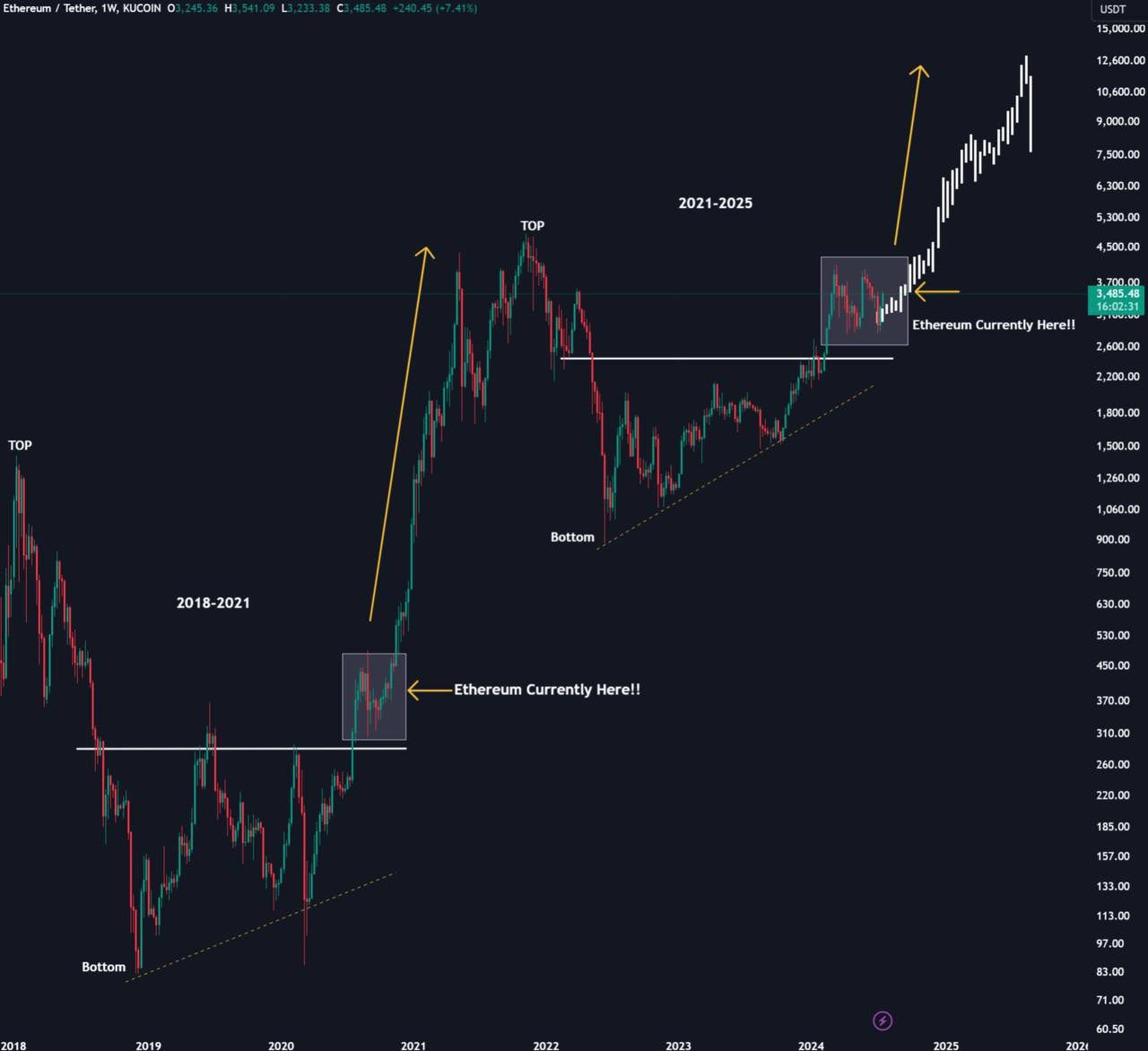
Here's my breakdown along with the risks and challenges I see
Ethereum as Digital Money: A Nuanced View
When I first looked at ETH, I was tempted to draw parallels with Bitcoin as digital money. However, the more I've studied it, the more I've realized that ETH's monetary properties are far more complex.
Unlike Bitcoin's fixed supply, ETH's supply is variable. It depends on the number of validators and network usage, which affects issuance and burn rates respectively. This variability makes me cautious about viewing ETH as a pure store of value. It's a double-edged sword - potentially beneficial for network security but introducing uncertainty for investors like myself who prefer predictable monetary policies.
What really gives me pause is Ethereum's ongoing development. The yearly upgrades, while driving innovation, introduce recurring technical risks. As an investor, this continuous evolution makes me question ETH's stability as a long-term store of value.
ETH's potential as a means of payment will be revolutionary. Its faster settlement times compared to Bitcoin (13 minutes vs. 1 hour) are promising. However, the fee volatility I've observed is a significant concern. Until this is addressed, I'm skeptical about its wide-scale adoption for everyday transactions.
The Yield Factor: A Game Changer
The transition to proof-of-stake with "The Merge" has fundamentally altered my view of ETH as an investment. It's no longer just a speculative digital asset; it's now a yield-bearing one.
I've been closely studying the validator rewards structure. The combination of protocol issuance, transaction tips, and Maximal Extractable Value (MEV) creates a compelling yield proposition. What's particularly interesting is how this yield correlates with network activity. The spike in rewards during high volatility periods, like November 2022, demonstrates the potential for significant returns during peak usage.
This yield component adds a new dimension to my investment thesis. It's more than just about price appreciation anymore, there's a tangible, ongoing return to consider.
Valuation
Valuing ETH has been one of my biggest challenges. Traditional models don't quite fit, and I've had to adapt my approach.
I've looked at demand-side metrics, comparing ETH to Bitcoin. What struck me was the weaker correlation between ETH's price and address growth. This suggests to me that ETH's value is more tied to network usage than pure monetary demand - a crucial distinction in my analysis.
I've also explored using a Discounted Cash Flow (DCF) model based on network fees. While this gives me some insight into the fee-value relationship, I'm wary of relying too heavily on it. The model's high sensitivity to growth and discount rate assumptions makes me cautious.
Network Growth
What's impressed me is Ethereum's ecosystem growth, particularly in the face of market downturns. The steady base layer transactions and increasing adoption of Layer 2 solutions signal to me a resilient and expanding network.
This growth trends positively in my investment thesis. It suggests a strong foundation for long-term value accrual, though I'm keeping a close eye on how scaling solutions might affect fee dynamics and, consequently, validator yields.
Risks and Challenges: Eyes Wide Open
There are several that I'm particularly mindful of:
Regulatory uncertainty: Recent actions in the U.S. have highlighted how regulatory decisions could significantly impact ETH's valuation and network health.
Technical risks: The ongoing development, while innovative, introduces continuous technical risks that I can't ignore.
Evolving tokenomics: Each upgrade has the potential to shift ETH's economic model, requiring constant reassessment of my investment thesis.
Conclusion: My Investment Stance
I see Ethereum as a high-potential, high-risk investment or so considered by the tradfi guys. Its position as a leading smart contract platform, combined with its new yield-bearing characteristics, presents a unique value proposition.
The evolving nature of Ethereum means my thesis will require constant reassessment. I'm particularly interested in how future scaling solutions and upgrades will affect ETH's value proposition.