

SEC crushed! ☠️
Rejections overturned for bitcoin ETF 🚀
You won’t believe the massive implications ahead 🧵👇

The DC Court of Appeals ruled that the SEC was wrong to reject Grayscale's application for a bitcoin ETF. This is a landmark decision that goes against the SEC's stance on bitcoin ETFs.
Grayscale case against SEC ruling puts pressure on the SEC to approve bitcoin ETFs, which could significantly impact bitcoin adoption and prices.
However, the SEC still has avenues to block approval, so the bitcoin ETF saga likely hasn't reached its conclusion yet.
The SEC has rejected many applications for bitcoin ETFs in the past, arguing they would be vulnerable to manipulation. The cryptocurrency industry disagrees and says a bitcoin ETF would allow mainstream investors easy exposure.
This court decision could pave the way for other bitcoin ETF applications to be approved, though the SEC could still appeal. It reflects the growing acceptance of cryptocurrencies in mainstream finance.
The price of bitcoin rose on the news, as investors anticipate greater mainstream adoption if bitcoin ETFs become available. However, SEC approval would still be required despite the court ruling.
Overall this is seen as a major win for cryptocurrency asset managers like Grayscale, who have been trying for years to work within the system to launch bitcoin ETFs. The court ruled the SEC was "arbitrary and capricious" in rejecting the applications.
🔷 What led to this lawsuit? 🔷
Grayscale took the unique step of suing the SEC over its spot bitcoin ETF rejection, using the approved futures ETFs as justification.
This led to the Appeals Court ruling against the SEC, which is a major development in the bitcoin ETF saga.
Here is what happened:
Grayscale applied to convert its existing Grayscale Bitcoin Trust (GBTC) into a spot bitcoin ETF listed on the NYSE Arca exchange.
The SEC denied this application in 2021, as it has denied many other spot bitcoin ETF applications. Its rationale is concern about market manipulation.
However, the SEC has approved bitcoin futures ETFs, which Grayscale and Arca proposed adopting similar protections as. But the SEC still rejected the application.
Grayscale sued the SEC over this rejection, arguing it was unjustified given the approved futures ETFs. This lawsuit was notable as other rejected firms like ARK, Fidelity, and Invesco did not sue.
The case went straight to the DC Court of Appeals since the defendant is a regulator.
The Appeals Court ruled the SEC was "arbitrary and capricious" in rejecting Grayscale's application, since the proposed maniputation protections mirrored approved futures ETFs.
🔷 What was Grayscale’s case? 🔷
Grayscale tried to argue there's no reason CME's approved futures oversight couldn't extend to spot markets too, providing better investor protections. But the SEC wanted more proof that would truly detect spot market manipulation.
This is a key dispute that the court ruling tried to resolve.
It was argued that the surveillance arrangements used for bitcoin futures ETFs should suffice for a spot bitcoin ETF too, since both products depend on bitcoin's price.
Bitcoin futures ETFs track CME bitcoin futures, which CME closely monitors to detect and prevent price manipulation in real-time.
Grayscale claimed that extending CME's surveillance to a spot bitcoin ETF would better protect investors, by applying that oversight to the main spot exchanges investors use.
Currently most US bitcoin investment occurs on less regulated spot exchanges, versus the regulated CME futures market.
However, the SEC maintained Grayscale lacks data to show CME's surveillance would sufficiently monitor spot market manipulation.
🔷 What did the court say? 🔷
The court determined the SEC did not provide adequate rationale for why spot and futures bitcoin markets should be treated differently, given the extensive similarities Grayscale highlighted.
By failing to justify the distinction, the SEC's decision was unjustified in the court's view.
The key parts of the DC Court of Appeals ruling are:
Grayscale demonstrated its proposed spot bitcoin ETF is "materially similar" to approved futures bitcoin ETFs.
This is because bitcoin and bitcoin futures prices are closely correlated, and the CME surveillance agreements are identical.
So the CME oversight should have the same ability to detect manipulation in spot or futures bitcoin markets.
The SEC never explained why Grayscale owning spot bitcoins rather than futures would affect CME's fraud detection ability.
Therefore, the court ruled the SEC was "arbitrary and capricious" in rejecting Grayscale's application.
🔷 What now? 🔷
This ruling favors bitcoin ETF approval, but the SEC may well continue to resist.
The court case has shifted the dynamics in favor of the cryptocurrency industry, but not fully settled the issue yet.
More SEC appeals and denials could still occur before final resolution.
The SEC has 45 days to appeal the decision to the Supreme Court or request an en banc panel review. It's unclear if they will appeal at this point.
If the SEC does not appeal, the court would give specific instructions on how the decision should be implemented.
This could involve directing the SEC to approve Grayscale's application.
But it could also just require the SEC to re-review the application, leaving open the possibility they reject it again on different grounds.
If approved, Grayscale would be the first spot bitcoin ETF in the US - a major development for mainstream bitcoin adoption.
However, the years-long bitcoin ETF saga likely isn't over until the SEC gives final approval. They still have avenues to oppose or stall spot bitcoin ETFs.
🔷 Implication for other applicants 🔷
The court victory benefits other applicants but doesn't guarantee approval.
Also, at the same time, there is a counterintuitive view with a bear case for $COIN Coinbase
Also, in the coming week, there are 6 SEC deadlines approaching and the SEC will need a very strong case to deny them again.
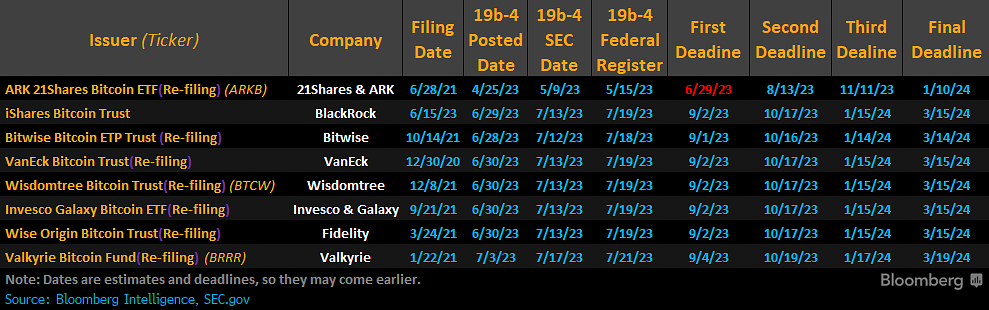
Though this victory strengthens the case for SEC approval, but the SEC can potentially still block spot bitcoin ETFs despite this ruling. The battle is not definitively over yet.
The implications of a Grayscale victory for other bitcoin ETF applicants include:
Several major firms like BlackRock, Fidelity, VanEck, and Bitwise have spot bitcoin ETF proposals pending before the SEC.
Many are working with crypto exchange Coinbase for market surveillance, unlike Grayscale working with CME.
The SEC now must formally acknowledge and decide on these applications within 240 days.
The Grayscale ruling doesn't necessarily mean the SEC must automatically approve other bitcoin ETFs.
But it could influence the SEC's decisions, as applicants can cite the court's reasoning that spot bitcoin markets can be sufficiently monitored.
This ruling lends momentum to the argument that spot bitcoin ETFs should be allowed, given appropriate surveillance measures.
However, the SEC still has latitude to find reasons to reject or stall applications if they remain opposed.
Read more here in the whitepaper:

Twitter: https://twitter.com/arndxt_xo/status/1697218234603409451