

We're at a macroeconomic crossroad.
What lies ahead?
I will unmask the boom or bust financial dynamics. 🧵👇

These recent developments highlight the delicate balance and fluctuations across different financial markets.
From the Fed's cautious approach to rising inflation and its impact on interest rates, to the divergence between crypto and traditional stock markets, investors are navigating through a dynamic landscape.
Let's also look at the macro landscape in terms of optimism and risks.
1️⃣ Macro events for the week
2️⃣ Fed Holds Rates, Eyes Inflation
3️⃣ Crypto Prices Decouple from Stocks
4️⃣ Tether De-peg
5️⃣ Global Insights: Shattering Negativity, Embrace Optimism
6️⃣ Banking Crisis and Looming Risks
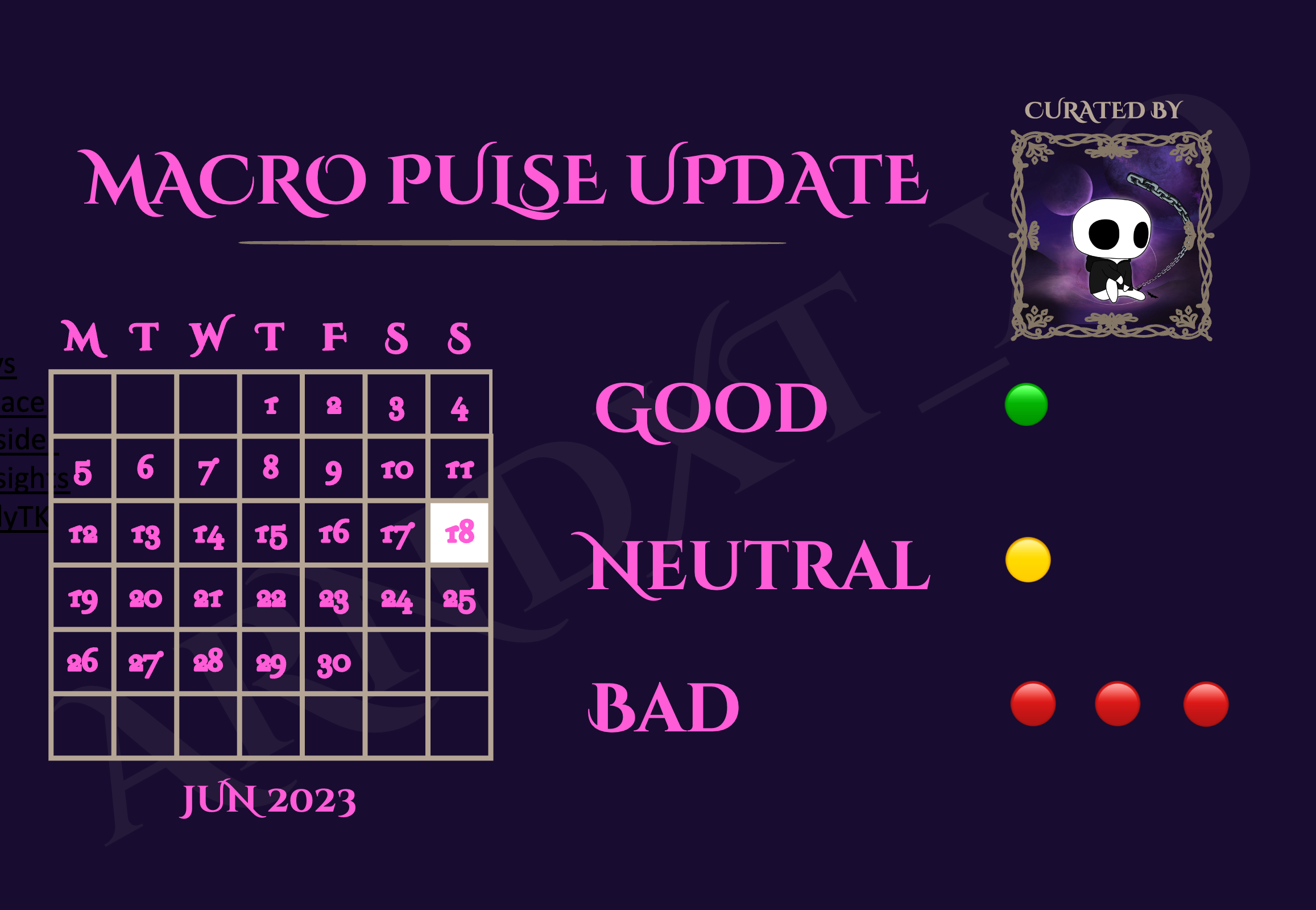
1️⃣ Macro events for the week

2️⃣ Fed Holds Rates, Eyes Inflation 🟡
In a widely anticipated move, the Fed decided to keep its interest rate, unchanged at 5-5.25%. This marks a significant shift from the 10 consecutive rate hikes we've seen in recent times.
While the Fed's statement and press conference maintained a cautious stance, hinting at potential future rate hikes if inflation persists, the decision to hold rates steady comes as a relief.

According to the Fed's projections, interest rates could still rise to around 5.6%, indicating the possibility of two more rate hikes before the year ends.

However, historically, we have not seen any hikes after a pause.
The stock market reacted with an initial dip, concerned about the prospect of future rate increases. However, it got back to pace, with a slight upward trajectory.
3️⃣ Crypto Prices Decouple from Stocks 🔴
In other news, the cryptocurrency market experienced a stumble while traditional stock markets continued their upward momentum. BTC, ETH recorded declines of approximately 7.8% and 10% respectively, as regulatory scrutiny in the U.S. weighed on crypto prices and investor sentiment.
Conversely, the S&P 500 and NASDAQ reached new 12-month highs, with the latter surpassing levels not seen since April 2022. This surge can be attributed to the robust performance of semiconductor and software industries, driven by the growing interest in artificial intelligence.
4️⃣ Tether De-peg 🔴
Adding to the market volatility, Tether (USDT), the world's largest stablecoin at $83b market cap, faced intermittent de-pegging, causing a sudden drop in crypto prices. While DAI overtakes BUSD as the top 3 stablecoin.

What happened with the USDT depeg?
There was an imbalance in liquidity pools, particularly on Curve, resulting from a significant sell-off of USDT, pushing its price temporarily below the 1:1 USD peg.
The Curve 3Pool experienced substantial shifts as traders exchanged USDT for other stablecoins. At one point, USDT dipped to approximately $0.996.

4️⃣ Global Insights: Shattering Negativity, Embrace Optimism 🟢
Europe's Economy Thrived Despite the Ukraine War
Despite concerns about the economic damage caused by the war in Ukraine, Europe is doing remarkably well, thanks in part to lower oil and gas prices. European governments have successfully secured alternative energy sources and provided financial support to offset rising energy prices, thereby contributing to sustainable economic growth.
Resilience of North American and European Economies
Contrary to expectations, both North America and Europe have shown remarkable resilience and avoided deep recessions. Factors such as lower energy prices and consumer spending supported by accumulated savings have played a significant role in its economic stability.Business Adapted to Remote Work
Despite initial concerns that the global economy was dysfunctional during the pandemic, businesses have adapted well to the use of technology for remote work. The economic impact is mitigated by the accelerated adoption of remote technologies may have lasting effects on the way we work.
Inflation Peaked and Declined
Concerns of high inflation prevailed in 2021, but inflation peaked in mid-2022 and has since declined in North America and Europe. Expectations are that major economies will return to low inflation by the end of 2024.Job Markets Remained Strong
Despite tighter monetary policy, labor markets in major economies remain tight, resulting in persistently low unemployment. Surprisingly, wages have not increased significantly, which means that labor costs have not significantly contributed to inflation.Borrowing Costs Remain Low
Despite the increase, borrowing costs in North America and Europe are at historically low levels. This is a sign of investor confidence that inflation will return to lower levels and reflects the large excess savings in the world. Companies can still access finance at a reasonable price, and borrowing costs could fall further in the coming year.Supply Chain Disruption Reversed Quickly
Global inflation caused by pandemic supply chain disruptions has quickly returned to normal. Supply chain stress indicators have fallen below pre-pandemic levels, shipping costs have fallen, and factors such as the lifting of COVID-19 restrictions in China are helping to restore supply chain stability.Vaccines and Return to Normalcy
Vaccines are being developed faster than expected, while the latest wave of COVID-19 has been relatively mild. People are gradually returning to normal life, and fewer and fewer people wearing masks are seen traveling.
5️⃣ Banking Crisis and Looming Risks 🔴
Banking crisis led to banks selling performing loans, but beyond that, there are potential risks that we will want to be aware of.
Banks in the US are selling performing commercial property loans due to two main reasons.
First, demand for the securities backed by these loans has fallen, leaving banks with more loans than they want. They sell them at a loss fearing that it will be difficult unload later.
Second, banks are concerned that high office vacancy rates due to telecommuting may lead to more vacancies in the future when leases expire and businesses fail to renew.
Retail and hospitality properties face similar problems with higher debt rates than office buildings. Smaller banks are more exposed to commercial real estate loans than larger banks.
Driven by rising interest rates and concerns about the safety of small banks, savers have switched from banks to money market funds. Banks may have to offer higher deposit rates to prevent further outflows, creating additional pressure.
The US Treasury is expected to issue a large number of securities in the coming months, which could lead to higher interest rates. Higher Fed Funds rates can lead to higher interest rates on bank deposits.
The Fed plan to sell assets after expanding its balance sheet in response to the failures of Silicon Valley banks could help boost yields.
Source: https://twitter.com/arndxt_xo/status/1670334171859001344