

🚨 “Not QE, QE” is coming – History says markets could react 🚨
The US Government is about to inject up to $830B into markets by drawing down its Treasury General Account (TGA).
It’s not technically QE, but it looks like QE, smells like QE, and might act like QE.
History suggests this could be very bullish for markets.
Let’s break it down 🧵👇
What’s happening?
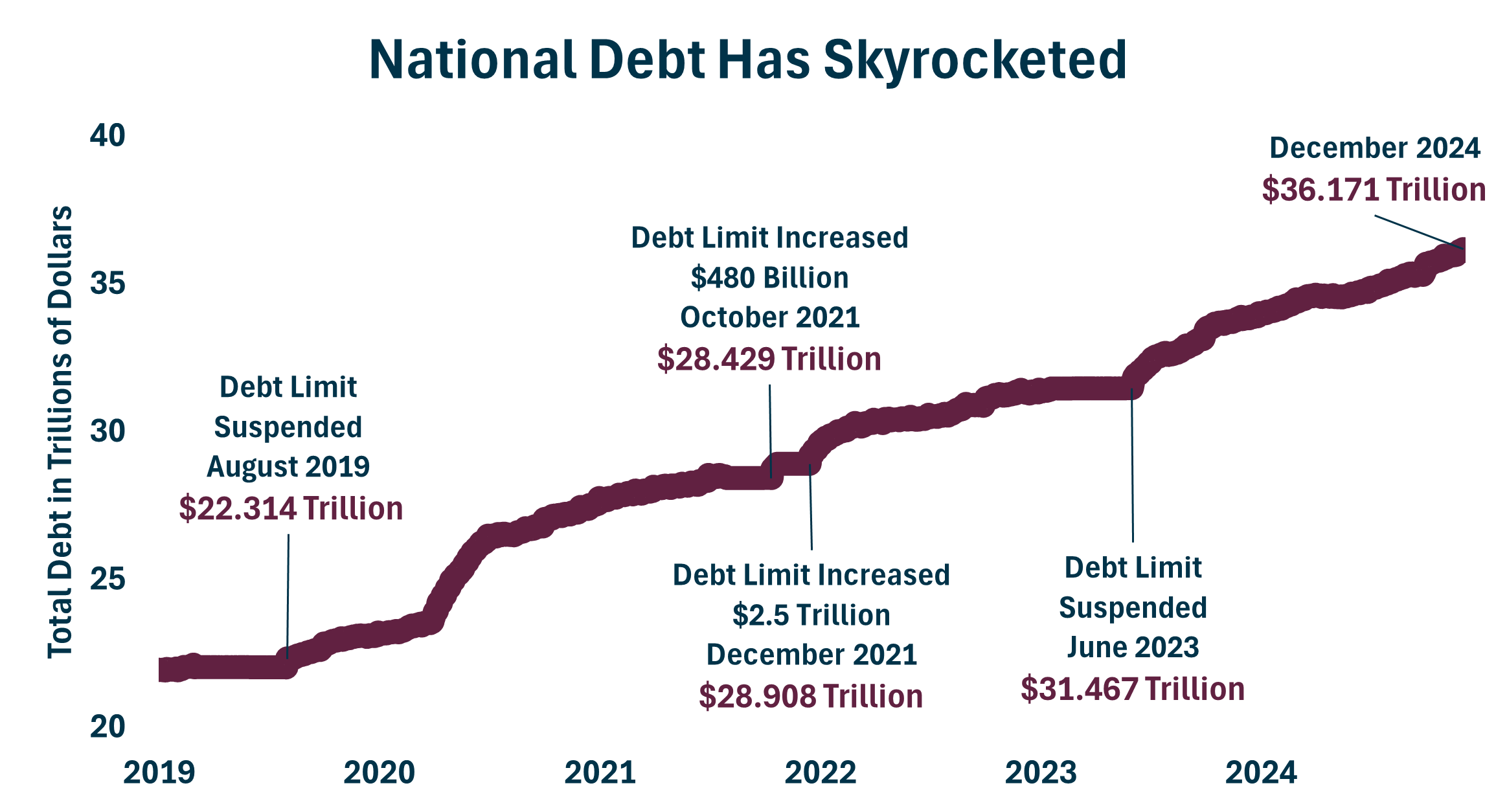
The US hit its $36T debt ceiling in January 2025. This means the government can’t borrow more money until Congress raises or suspends the limit.
But the government still has bills to pay…
What’s the TGA?
Think of it as the US Government’s checking account at the Fed. Right now, it has $830B sitting idle.
Since borrowing is off the table (for now), the government will spend directly from the TGA to stay operational.
This pushes money back into circulation, increasing liquidity.
Why does this matter?
When money sits in the TGA, it’s out of the economy.
When the government spends from it, that money flows back into markets—just like a liquidity injection.
It’s functionally similar to QE.
How is this like QE?
• QE (Quantitative Easing) = The Fed prints money & buys bonds, adding liquidity.
• TGA Drawdown = The Treasury spends existing money, injecting it into markets.
Both increase bank reserves & liquidity, which often drives asset prices up.
Historical TGA Drawdowns & Market Reactions
📉 March 2020 – COVID Crash & Recovery
• Key Driver: QE + Stimulus Spending (TGA)
• The Fed unleashed unprecedented QE ($3T in asset purchases).
• Simultaneously, the US government spent trillions from the TGA on stimulus checks, PPP loans, and unemployment benefits.
• TGA fell from $400B → $100B, adding liquidity.
✅ Markets bottomed on March 23, 2020, then surged as liquidity flooded in.
Conclusion: Both QE & TGA played a role, but QE was dominant.
📈 March–July 2021 – Post-COVID Stimulus Boom
• Key Driver: TGA Drawdown ($1.6T → $300B)
• The Fed was already slowing QE, but the government was still spending from the TGA reserves.
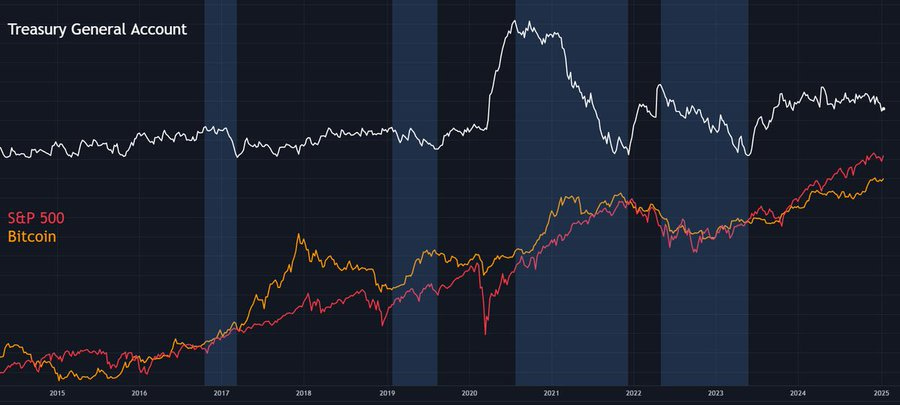
• This fueled stock market & crypto all-time highs in late 2021.
• Once the TGA was refilled in late 2021, markets slowed.
Conclusion: TGA Drawdown was the primary factor.
📉 July–December 2022 – Bear Market Liquidity Boost
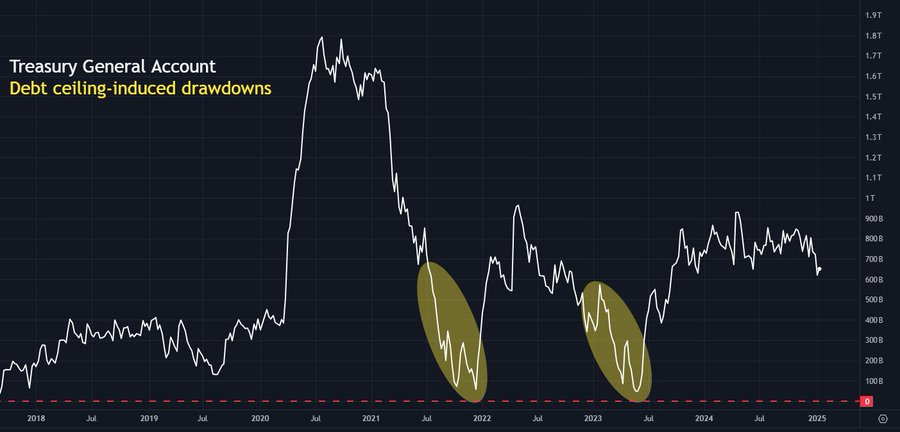
• Key Driver: TGA Drawdown ($900B → $400B)
• The Fed was actually doing QT (Quantitative Tightening)—reducing its balance sheet.
• Yet, markets still saw a 17% relief rally in Q3 2022.
• Why? Because the TGA drawdown was adding back liquidity even as QT drained it.
Conclusion: TGA played a major role in supporting markets.
📈 March–June 2023 – Market Liquidity Pump
• Key Driver: TGA Drawdown ($500B → $80B)
• This period did NOT have QE—the Fed was still in QT mode.
• Yet, markets rallied +19%, and Bitcoin surged from $20K to $30K.
• Once the TGA was refilled post-debt ceiling deal (June 2023), markets slowed down.
Conclusion: TGA drawdown fueled the rally, despite Fed QT.
How big is this injection?
Estimated $600B in new liquidity between mid-February & early April 2025.
However, two major tax payment periods (April & June) will temporarily reduce liquidity as tax revenue flows into the TGA.
When does this stop?
• The “X-date” (when the government fully runs out of money) is estimated around August 2025.
• If Congress delays raising the debt ceiling (which they usually do), the TGA drawdown continues.
• Once a deal is reached, the TGA will be refilled, draining liquidity out of the system.
Key Indicators to Watch
✅ Short-term liquidity boost → Could fuel a market rally like 2020, 2021, 2022, & 2023.
✅ Debt ceiling standoff → The longer it lasts, the more liquidity gets injected.
✅ Tax payment periods (April & June 2025) → Temporary liquidity drain.
✅ Fed balance sheet activity → Could amplify or offset the impact.
What About This Time? (2025 TGA Drawdown)
Now, the Fed is NOT doing QE, but the TGA will inject liquidity into markets.
🔹 If history repeats, TGA drawdowns alone have been enough to drive rallies—even without QE.
🔹 However, if the Fed counteracts it (e.g., more QT, rate hikes), the effect might be weaker.
Bottom Line
• QE & TGA drawdowns BOTH inject liquidity, but they come from different places.
• In 2021, 2022, and 2023, TGA drawdowns alone boosted markets—even when QE was absent.
• This upcoming TGA drawdown ($600B–$830B) could create a similar market effect in 2025.
• Liquidity injections have historically fueled stocks, crypto, and risk assets.
• The TGA drawdown is NOT QE, but it acts like QE, so markets could respond similarly.
• Once the debt ceiling is raised & the TGA is refilled, liquidity will be drained, which could reverse the effect.