

congrats if you shorted $ZAMA with me and @0xToolman, possible only on variational
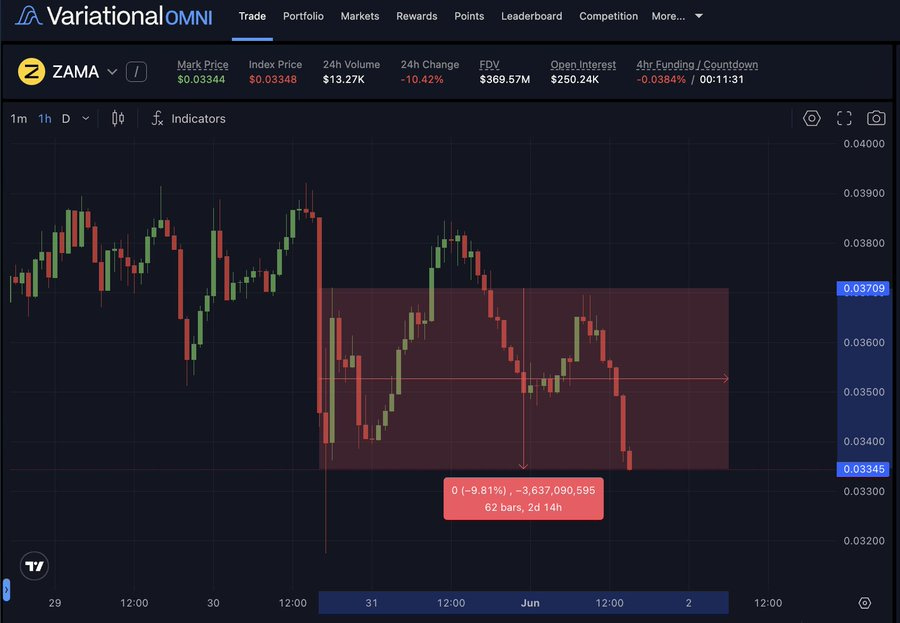
[ you get 12% more points boosts and instant upgrade to bronze tier if you trade here. ]
its interesting because it is not trying to be another hyperliquid clone.
the core thesis is that different markets require different market structures.
for highly liquid crypto majors, a clob works well because there is enough organic two-sided flow. btc, eth, sol, hype-style markets can sustain visible order books because market makers have enough volume, volatility, and incentive to quote tightly.
but rwa and tradfi-style perps are different
most of these markets will not have deep organic liquidity on day one. if you list hundreds of long-tail equities, commodities, rates, indices, or thematic assets on a normal order book, liquidity fragments quickly. spreads widen, depth disappears, and the market becomes unusable.
this is where @variational_io RFQ model matters.
instead of relying only on passive order book liquidity, variational is building a system where liquidity can be sourced and priced dynamically. the goal is not just more markets, but instantly tradable markets.
hyperliquid is closer to a decentralized NASDAQ: transparent, order-book-native, highly performant, and strongest where liquidity already concentrates.
variational is closer to a decentralized : broader market coverage, easier retail access, zero-fee trading, private execution, and the ambition to make almost anything tradable onchain.
the bet is that the next phase of perp dex growth does not come only from better execution on btc and eth.
it comes from expanding the asset universe.
crypto perps already exist everywhere. the harder opportunity is bringing rwa, tradfi, social-fi, mindshare, and long-tail markets onchain with usable liquidity.
that is why the rwa trading competition is strategically important.
it is not just an airdrop farming event, it is also a liquidity bootstrapping mechanism.
by boosting rwa markets with points and running leaderboards around roi, pnl, and volume, variational is incentivizing users to stress-test the exact markets
the competition reveals three things:
- whether traders actually want rwa perps
whether spreads and execution remain competitive under activity
- whether variational can create liquidity where clob venues struggle
- the $250k volume requirement also matters. it filters out tiny sybil accounts and forces real trading activity, while still being accessible enough for active retail users.
- this is a smart design because it rewards both skill and usage.
together, they push users toward meaningful participation instead of passive point farming.
if @HyperliquidX proved that decentralized perps can compete with centralized exchanges, variational is trying to prove that decentralized brokers can compete with retail trading apps.
the market structure thesis is simple:
- clobs are excellent when liquidity is already dense.
- RFA is better when markets are fragmented, long-tail, or institutionally priced.
this is why variational is especially relevant for rwa perps.
rwa markets need breadth before they have depth.
a pure order book model struggles there.
the risk, of course, is that zero fees and tight spreads must be economically sustainable. if execution quality depends too heavily on internalized liquidity or subsidized flow, the model needs enough volume, hedging efficiency, and market-maker profitability to survive beyond incentives.
that is the high-level thesis:
hyperliquid proved onchain order books can work.
variational is betting that the next unlock is not a better order book, but a better liquidity architecture for everything that does not naturally fit inside one.


